

Welcome to Staten News — where the AI race is starting to look less like a sprint and more like a geopolitical cage match fought with semiconductors, lawyers, and data centers.
This week’s biggest story came out of Hamburg, Germany, where the latest TOP500 rankings delivered a headline few expected to see again this soon:
China is back on top. And it got there without a single Nvidia chip.
📱🔌 China Just Sent a Message to Washington
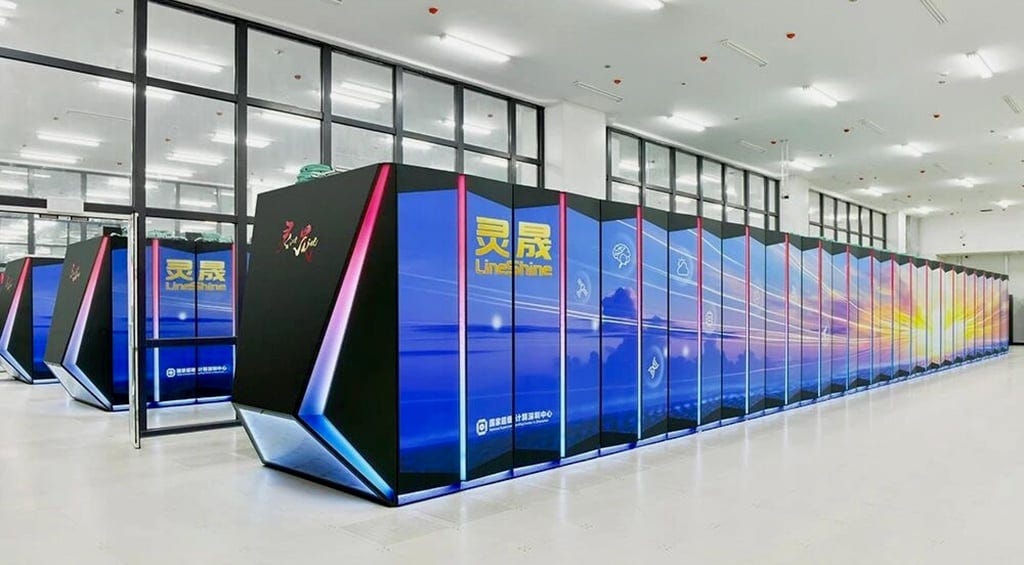
For the first time since 2017, China owns the world’s fastest supercomputer.
The machine, called LineShine, is housed at the National Supercomputing Center in Shenzhen and posted 2.198 exaflops on the industry’s standard benchmark.
That’s roughly 20% faster than America’s current heavyweight champion, El Capitan.
But the speed isn’t the most important part of the story.
What’s inside the machine is.
LineShine runs on roughly 47,000 domestically designed processors, with no Nvidia GPUs, no AMD hardware, and none of the cutting-edge American silicon that export controls were designed to keep out of China’s hands.
In other words:
China just built a world-leading supercomputer using chips it was forced to build itself.
That’s the headline policymakers in Washington are likely paying attention to this morning.
🤖 The Fine Print Matters
Before anyone starts engraving championship trophies, there is an important caveat.
The benchmark that gave LineShine the crown primarily measures scientific computing performance—think weather simulations, physics models, and research workloads.
AI is a different game.
When evaluated on HPL-MxP, a benchmark designed to resemble real-world AI training tasks, LineShine falls to fourth place.
America’s El Capitan remains the leader there by a wide margin.
Several industry experts were quick to point out that the largest AI clusters operated by Microsoft, Google, Amazon, and other hyperscalers aren’t even submitted to these rankings.
If they were, the leaderboard would likely look very different.
That’s why this announcement feels less like a declaration of AI dominance and more like a geopolitical statement.
China isn’t saying, “We’re winning.”
It’s saying, “We’re still here.”
And that’s a message the rest of the world is hearing loud and clear.
🌏 The Export Control Question Gets More Complicated
Perhaps the most interesting question is why China submitted the system at all.
For years, Chinese supercomputing projects largely disappeared from public rankings, avoiding the spotlight as export restrictions tightened.
Now they’re back.
Many analysts see this as a deliberate show of strength.
A public demonstration that years of forced self-sufficiency have produced tangible results.
The uncomfortable reality for Western policymakers is that restrictions may have changed China’s path without stopping its destination.
The strategy limited access to foreign technology.
It did not eliminate China’s incentive to build alternatives.
LineShine is proof of that.
The machine exists because the restrictions existed.
⚖️ Anthropic’s Shutdown Is Now a Court Case
Meanwhile, the Anthropic saga just got significantly messier.
Legion, a U.S.-based legal-tech startup, filed suit against the federal government over the June 12 export-control directive that forced Anthropic to shut down access to its Fable 5 and Mythos 5 models worldwide.
The company argues the shutdown caused immediate harm to products actively being developed by its engineering teams, including employees working from Canada.
Its lawsuit seeks to block enforcement of the directive and overturn it entirely.
The broader concern extends far beyond a single startup.
Many companies are now asking a simple question:
If access to a major AI model can disappear within days, what does that mean for businesses building products on top of those models?
That’s the uncertainty hanging over the entire AI ecosystem right now.
📉 Alphabet Had a Brutal Week
While legal battles and supercomputers grabbed headlines, Wall Street delivered its own verdict on Big Tech.
Alphabet suffered its worst trading day in more than a year, sliding roughly 5% amid growing AI concerns and a series of high-profile executive departures.
The stock isn’t alone.
AI infrastructure names across the market have been under pressure as investors reassess growth expectations and spending assumptions.
The same concerns hitting memory-chip stocks this week are now spreading throughout the broader AI trade.
For much of the last two years, “AI” was enough to make investors hit the buy button.
Now they’re starting to ask harder questions.
Revenue.
Margins.
Returns.
Timing.
The honeymoon phase appears to be ending.
🔄 Meta’s Own AI Irony
Meta also found itself in the headlines.
The company announced leadership changes at WhatsApp, naming fintech entrepreneur Kunal Shah to lead the platform following the departure of its previous chief.
At the same time, Meta reportedly paused an internal employee-monitoring initiative that had been used to train AI systems after the program exposed information it wasn’t supposed to.
It’s a fitting snapshot of the current AI era.
Companies are racing to build smarter systems while simultaneously discovering how difficult those systems can be to control.
Move fast and break things sounds a lot less fun when the thing being broken is your internal data.
🔮 The Bigger Story
This week’s headlines may look disconnected.
A Chinese supercomputer.
An AI lawsuit.
Alphabet’s selloff.
Meta’s internal problems.
They’re actually pieces of the same story.
For years, the AI boom was mostly about possibility.
Now it’s increasingly about constraints.
Energy.
Water.
Regulation.
Export controls.
Infrastructure.
National security.
Legal liability.
Those challenges are arriving faster than governments and corporations are prepared to handle them.
China just demonstrated that restrictions can redirect innovation rather than stop it.
Anthropic is watching a lawsuit unfold over a government decision it publicly disagrees with.
And every major AI company is realizing that building powerful models may be easier than navigating the world those models operate in.
📡 Final Thoughts
The AI race isn’t slowing down.
It’s getting more complicated.
The winners won’t simply be the companies with the smartest models or the fastest chips.
They’ll be the organizations that can navigate regulation, infrastructure, geopolitics, and public trust at the same time.
This week showed us something important:
The future of AI won’t be decided solely inside laboratories.
It’ll be decided in courtrooms, data centers, government offices, and boardrooms.
And that battle is only getting started.
— The Bandicoots 📱🔌